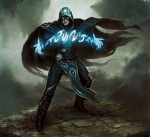
For those who might be interested, this is a snapshot of the species I have detailed for the game (sans mechanics). These are not the only ones: I am still creating more species, but these are the ones I have detailed so far.
Androids
Appearance: Androids look human and can easily pass for such (except under examination by a physician). They do not need to eat, drink, sleep, or breathe, though many may simulate doing so to further the illusion of humanity.
Culture: Androids do not have a culture of their own. Their advanced neural network gives them artificial intelligence complete with individual personalities, quirks, and emotions, just like any other sapient being. In most parts of the galaxy, they have no legal rights, a problem that the AADL (Android Anti-Defamation League) is fighting to correct.
Alloi (ah-
loh-eye)
Appearance: Alloi look human and could easily pass for such. In fact, many do, going unnoticed among humans. They have the same range of hair, skin, and eye colors that humans possess.
Culture: These mild-mannered telepaths are a race of peaceful explorers that roam the galaxy, learning about other species. They live to meet new species, visit new worlds, etc. They tend to hide their powers among humans so as not to be marked as psionics.
Auncar (awn-
car)
Appearance: The cold-blooded Auncar bear a striking resemblance to humanoid lizards. They are covered in fine, flexible scales that come in a variety of colors. All have tails that range from thick to whiplike. Their eyes are typically yellow. They have a venomous bite and can project their venom from glands in their mouths.
Culture: Auncar live in extended family units and are very proud of their lineages. They prefer their food to be warm and alive, though they are capable of digesting carrion. They do not eat other sentients. Space travel is relatively new to the Auncar, as they only progressed to their Interstellar Age a few decades ago.
Bhohmair (boh-
mare)
Appearance: The blue-skinned and white-haired Bhohmair hail from a frozen world that is locked in near-constant darkness. Over the generations, they have lost their ability to see and have developed a sense of echolocation to make up for this handicap. By emitting a series of chirps and clicks, they are able to navigate almost as well as sighted individuals.
Culture: Bhohmair culture is built around their handicap. They have no written language, and their history is kept through a sort of racial memory. Likewise, pictures and videos are unknown to them. When dealing with sighted races, they utilize a special device that describes what is being seen to them.
Camadar (
cam-ah-dar)
Appearance: Camadar are four-legged, four-armed centauroid cat-like beings. They are covered in short fur (except their heads, which have hair), the patterns of which vary according to their environment. Camadar from grasslands tend to have tawny fur with spots, whereas those from jungle regions tend to bear stripes. Most Camadar do not wear clothing. Modesty is not a common trait among them.
Culture: Camadar live in tribal units that are much like extended families. Most are nomadic and are constantly on the move, following the herd animals on their homeworld. A rite of passage for young Camadar is to hunt the fiercest predator in their world, armed with only a stone-tipped spear and a flint knife.
Cik (
sik)
Appearance: Cik are amorphous, naturally gelatinous beings who typically maintain a humanoid shape among other races. They do not speak but communicate with bioluminescence. Their world has an oppressively heavy atmosphere that dampens sound, so they developed this unique way of "speaking".
Culture: The Cik do not have male or female genders but reproduce asexually. In their own environment, they do not assume any particular form but instead allow their muscles to relax, becoming shapeless blobs.
Draix (
drayks)
Appearance: Draix have thick, rock-like skin, and though slow and ponderous, are very tough. They do not wear clothes, but many wear toolbelts or carry shoulder bags simply for the convenience of pockets. Draix do not have body hair and all have red eyes.
Culture: They are a race of thinkers and philosophers that, despite appearances, are peaceful. This does not mean that they are pacifists or helpless, however. They are very capable of defending themselves, as more than one aggressor has learned, usually to their chagrin.
Elphih (
el-fee)
Appearance: These winged beings soar on the fierce air currents of their homeworld. They are physically frail due to their hollow bones, but make up for it with great agility and fierce determination. Hair and eye colors run the gamut of human colors, but they are covered in soft feathers, the colors of which vary widely. Males tend to be brighter and more vibrant than females.
Culture: The Elphih live in nests atop the great mountains of their homeworld. They are oviparous, with the females typically laying a clutch of 2-5 eggs. Elphih are monogamous and mate for life.
Ezol (
ee-zawl)
Appearance: Ezol look like humanoid cats. They are covered in fur, which ranges from short to long, and have heads full of hair. The patterns of their fur vary wildly, as do the colors, but their eyes are typically blue, green, or dull yellow.
Culture: Arrogant and aggressive, the Ezol make the best rship pilots in the galaxy, and they know it. Few can match their reflexes and talent for piloting. This is not due to training, but rather seems to be an inborn instinct.
Felte (
felt)
Appearance: Felte could pass for humans, except for their green-hued skin, purple hair and eyes, four arms, and antennae. The hue of the skin ranges from light to dark, and the same with their hair.
Culture: Felte are highly skilled with all things mechanical and are greatly prized as engineers. Theirs is a high-technology society, and they eagerly embrace new ideas and gadgets. Felte love tinkering with things, always seeking to improve existing technology.
Gennie (
gee-nee)
Appearance: Gennies are genetically created beings designed by humans for specific purposes. They are as varied in appearance as humans are, some even looking nothing remotely human. Each is tailored to the job they are performing.
Culture: The creation and use of gennies is controversial, with many people believing that they should be afforded full rights as galactic citizens, but thus far, the law remains unchanged. Some typical (but by no means the only) gennies are:
• Miner: Primarily created to mine asteroids for valuable minerals, they must wear protective gear, but are created to be strong and fit.
• Soldier: The soldier gennie is intended to be the perfect combatant; tough, fast on the draw, and obedient.
• Worker: Developed for construction work in zero-g, the worker is designed to operate in micro-gravity conditions.
Humans
Appearance: Humans are relatively unchanged in the 26th century. Their hair colors run the gamut of blondes, browns, and black and their skin likewise ranges from black to olive tan. Eye colors are typically blue, brown, green, or hazel, with brown being the most common.
Culture: There are literally thousands of human cultures in the known galaxy, far too many to list.
Idro (id-
row)
Appearance: Idro are humanoid, with grey skin, no body or head hair, and large, blue-grey eyes. Their noses are practically non-existent, and their mouths are lipless.
Culture: The Idro are highly sociable beings that suffer greatly when separated from one another. Between themselves, they share a telepathic bond and can communicate wordlessly. They are capable of communicating verbally with other species, however.
Kasa (cah-
sah)
Appearance: Kasa are plant-based lifeforms with two eyes mounted on stalks, thick bodies that resemble a pineapple topped with a palm, and multiple small tendrils that serve both as fingers and as a means of locomotion. They do not eat in the conventional sense, instead gaining nutrients through soil and sunlight.
Culture: Surprisingly, the Kasa have a fairly advanced culture. They achieved spaceflight about a century ago and have made great strides in technology. Due to their unusual physiology, however, they must wear custom-made clothing, spacesuits, and armor. Among themselves, they tend not to bother with clothing.
Kheks (
keks)
Appearance: Tall and lanky, the Kheks have bright orange skin, green eyes with no pupils, and superior physical strength. Males shave their heads save for a single topknot. In their own culture, they wear loincloths and simple tops for modesty.
Culture: These eight-foot tall bipeds are fierce warriors, though they use low-tech weapons, as their society has barely achieved
an Iron Age level of technology. They have a highly developed sense of honor and never break their word.
Lalluns (
lay-loons)
Appearance: The Lalluns are a race of shapeshifters that can assume the forms of other beings, even duplicating them down to fingerprints, retinas, and other distinguishing features. In their actual form, they are rather distinctive, with beady eyes, no nose, and a thin, lipless mouth. Their skin color is pasty white, and they have no body hair in their natural form.
Culture: The Lalluns have no culture of their own. Rather, they assimilate other cultures into their daily practices. The result is a mishmash of customs, rules, and laws that are very confusing to non-natives.
Mam’ull (mom-
ool)
Appearance: Mam’ull have thick shells into which they can withdraw (much in the manner of Terran turtles). They have tentacles instead of arms and hands, and these are flexible enough to stretch a short distance. Like the turtles they resemble, they have no body hair.
Culture: Mam’ull are a nomadic people, always moving. Theirs is a world of extreme storms, and they must constantly stay on the move in order to remain within the relatively small safe zones afforded by the eyes of the storms.
Memhurs (mem-
hers)
Appearance: Memhurs exist primarily in energy form and require the use of specialized pressure suits to function in any crew capacity. Outside of these suits, they look like ghostly, electric blue figures that crackle with energy.
Culture: Memhurs have little in the way of culture, being primarily floating bundles of energy.
Omir (
oh-meer)
Appearance: Tall, with short hair that covers their bodies, pointed ears that come off the tops of their heads, and a canine muzzle mark the appearance of the Omir. Their fur is typically darker grey at birth, gradually becoming lighter as they age. Their eyes are almost universally yellow, though a very few have ice blue eyes.
Culture: It is believed that, at some point in the past, a species uplifted Terran wolves to the level of sentience. The Omir are quick-tempered, but also capable of great restraint. They live in packs, led by an alpha male and an alpha female.
Phinid (
fee-nid)
Appearance: Phinid are a humanoid race that is obviously alien. Their dull grey skin and white, pupilless eyes are a dead giveaway as to their nature. Beneath the skin, networks of wires crisscross their bodies, and they have the ability to directly interface with computers via small wires that emerge from their fingertips.
Culture: The Phinid are unique in that they are both artificially created and that they are a dying race. No one is certain exactly who created them, when, or why, but they are incapable of reproduction and, as a result, are slowly dying out. Unlike Androids (q.v.), the Phinid are not able to pass for human without disguises or significant alterations to their bodies.
Qax’ix (
kak-ziks)
Appearance: The Qax’ix are very frightening in appearance, looking like humanoid skeletons at first glance. They actually do have flesh and muscle, but it is translucent, and their skeleton shows through the skin. They have no body or head hair and are fascinated with such.
Culture: Clothing and decoration are very important to the Qax’ix, as might be expected from a culture where it is difficult to tell one another apart. Wigs are very popular among the Qax’ix, as are textiles of various types.
Sa’rri (
saw-ree)
Appearance: The Sa’rri are humanoid, with webbed fingers and toes and big eyes. Their skin is a light blue color due to high concentrations of cobalt in their blood. They have only three fingers and a thumb on each hand. They can see in darkness and have nictitating membranes that protect their eyes from bright lights, as well as resistance to radiation.
Culture: The Sa’rri homeworld is located next to a variable star and is subject to frequent bursts of strong radiation. The populace lives deep beneath the surface of the world’s oceans. Their culture is a base eight instead of ten.
Shaihrads (share-
ads)
Appearance: Shaihrads are a snakelike species; tall and scaled, with wide heads, long necks and limbs, and fangs. Like the Auncar (q.v.), they are reptilian (though not cold-blooded) and venomous, though they cannot project their venom. They are very flexible, and most are double-jointed.
Culture: The Shaihrad homeworld is tidally locked with its star, resulting in a world of climatic extremes. On one side, the side facing the star is hot enough to melt lead, while the other side is well below freezing. Between the two, there is a small (about 50 miles across) temperate zone where the Shaihrad can exist in relative comfort.
Xol (
zol)
Appearance: This insectoid species has compound eyes, mandibles, antennae, and wings that fold tightly against its back, creating a carapace. They resemble a cross between a humanoid ant and a beetle, though they have only two arms and two legs. They speak a strange language of clicks and buzzes and must use translation devices among other species.
Culture: Xol culture is as strange as their appearance. They live in a hive-like hierarchy, within designated castes: worker, warrior, producer, and royalty. They do not wear clothing (indeed, the concept is completely alien to them).
Zaim’oi (zam-
oy)
Appearance: Zaim’oi are the galaxy’s smallest sentients, standing about 5" tall and weighing only a few ounces. They are covered in sandy-brown fur and are bipedal, with cat-like ears atop their heads. Their mouse-like muzzles are filled with needle-sharp teeth.
Culture: The Zaim’oi are so small that their culture revolves around proving their worth to other species. They approach everything in life as a new challenge and rise to meet it readily. They fear little, despite their size, and will stand up to creatures many times their size (though with an air of caution).
Last edited April 18, 2026 1:19 am